Proven AI Success: Case Studies & Impact
Explore how I’ve supported Technology Providers to build market-leading AI products and guided Asset Operators to achieve significant operational efficiencies and cost savings. Each case study details the business challenges addressed, the strategic AI solutions I delivered, and the measurable value generated.
Overview of Key Impacts
-
Integrating Statistical Models to Enhance Digital Twin Diagnostics
-
Strategic R&D: Evaluating ML Models for Time-Series Forecasting
-
Foundational Expertise: Advanced Data Analysis & Innovative Modeling
Success Stories & AI Innovations
Enhancing a Core Diagnostic Engine with Advanced Anomaly Detection
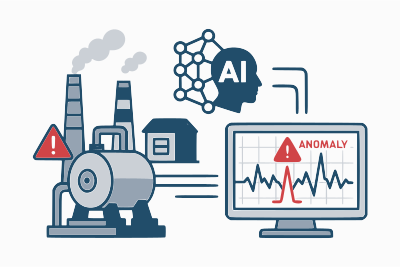
For a leading SaaS provider of industrial diagnostics, I helped enhance their core AI product by designing and deploying a next-generation anomaly detection and MLOps framework.
-
The Strategic Challenge: The company’s mission is to provide real-time, reliable diagnostics for complex industrial assets. To maintain market leadership and scale its impact, there was a critical need to enhance the core diagnostic engine with more advanced, scalable, and interpretable machine learning algorithms.
- My Strategic Solution & Implementation: I spearheaded the algorithmic strategy and was a key driver in establishing a robust MLOps framework for the core product. My contributions included:
- Designing, benchmarking, and deploying a suite of advanced anomaly detection algorithms (causal and non-causal, e.g., Isolation Forest, PCA-clustering) tailored for complex industrial data.
- Developing a novel mock-fault injection framework for rigorous pre-deployment validation, ensuring the high reliability required for mission-critical systems.
- Establishing and benchmarking robust MLOps pipelines for efficient model training, scalable deployment, and continuous performance monitoring.
- Experimenting with different explainability frameworks to pinpoint anomaly drivers, a key feature for end-user adoption and trust.
- Improving CI/CD practices and transitioning the algorithmic codebase to a newer Python version.
- Measurable Business Value Delivered:
- Contributed directly to the core technology that enables the company to identify 2 TWh of energy losses annually across its global fleet of 75+ industrial assets.
- Significantly improved anomaly detection accuracy and model interpretability, reinforcing the platform’s publicly stated 90% diagnostic accuracy and leading to more reliable, actionable fault warnings for end-users.
- The robust MLOps processes reduced model deployment times and enhanced platform reliability, enabling faster delivery of value to clients.
- Strengthened the company’s position as an innovator in the industrial AI space by integrating cutting-edge ML techniques into its core product.
-
Key Learnings for Asset Operators & Technology Providers: This project underscored the critical importance of robust MLOps, mock-fault validation, and model explainability for building trustworthy and scalable AI in mission-critical industrial systems.
- Key Technologies & Methodologies: Python, Advanced Anomaly Detection Algorithms (AAKR, Isolation Forest, Clustering, Causal Methods), Strategic MLOps Design (Kubernetes, NATS, GitHub Actions, Seldon), Custom Mock-Fault Generation & Validation, Model Explainability (SHAP), Performance Benchmarking, CI/CD (GitHub Actions).
Industrializing Data Ingestion for Global Scalability
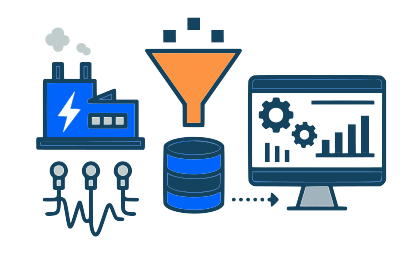
For a rapidly scaling SaaS provider, this project transformed an ad-hoc approach to client data ingestion into an industrialized, standardized ETL pipeline adopted by the entire Data Science team.
-
The Strategic Challenge: To support its rapid international growth and the onboarding of over 75 industrial assets, the company needed to move beyond custom-coded data handling. The challenge was to create a universal, scalable, and reliable ETL pipeline to manage diverse industrial data formats efficiently and accelerate time-to-value for new clients.
- My Strategic Solution & Implementation: I architected and developed a universal Python-based ETL pipeline. Key features included:
- Adaptive parsing for various file types (CSV, multi-sheet/multi-table Excel) with automated header merging and blank row discarding.
- Robust timestamp/timezone correction, tag sanitization (handling forbidden characters, ensuring casing consistency), and data validation against existing database schemas.
- Chunk-based processing and optimized calculations for handling large, multi-year datasets efficiently.
- Comprehensive error handling, logging, and partial re-upload strategies.
- Integration with CI/CD (GitHub Actions, linting, semantic versioning) and extensive documentation and hands-on team training for company-wide adoption.
- Measurable Business Value Delivered:
- Enabled a scalable, standardized data ingestion process that was adopted by the entire data science team, becoming a cornerstone of the company’s deployment methodology.
- Significantly accelerated client onboarding and the calibration of the core Digital Twin product, reducing project risks and improving overall data quality.
- Enhanced internal efficiency and knowledge sharing, allowing the team to focus on high-value analysis rather than repetitive data cleaning.
- Improved customer satisfaction due to faster, more reliable deployments and fewer data-related back-and-forth requests.
-
Key Learnings for Technology Providers & Asset Operators: This initiative highlights the foundational role of standardized, robust data ingestion pipelines in any successful AI deployment. Ensuring data quality and accessibility from the outset is paramount for achieving reliable analytical outcomes and operational scalability.
- Key Technologies & Methodologies: Python, Pandas, Custom ETL Architecture, Advanced File Parsing (CSV/Excel), Time-Zone/Timestamp Correction, Data Validation & Sanitization, CI/CD (GitHub Actions), Chunk-based Processing, Comprehensive Documentation & Team Training.
Integrating Statistical Models to Enhance Digital Twin Diagnostics
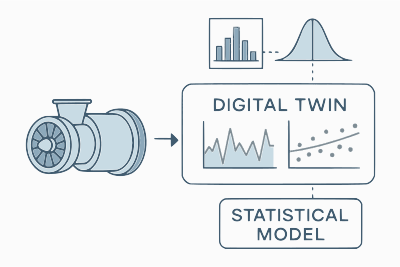
For a leading provider of industrial diagnostics, this project showcased how the core Digital Twin product could be enhanced by integrating advanced statistical models, directly supporting the company’s publicly stated R&D strategy of creating hybrid modeling solutions.1,2
-
The Strategic Initiative: The company’s core product relied on high-fidelity, physics-based Digital Twins. This project was a strategic R&D initiative to explore the integration of complementary data-driven statistical models in order to create a hybrid AI system to enhance diagnostic accuracy for key assets like Combined Cycle Gas Turbines (CCGT).1,2
- My Strategic Solution & Implementation: I led the development and benchmarking of advanced statistical models designed to complement the existing physics-based system. This involved:
- Implementing a novel “best-performance” data filtering technique, using custom data clustering and binning to isolate optimal operational data for training.
- Robust feature engineering from sensor data, including correlation analysis to eliminate redundancies.
- Leading a rigorous comparative analysis of statistical models against the traditional physical models, focusing on key CCGT performance parameters.
- Ensuring statistical model outputs could be seamlessly integrated into the existing Modelica-based digital twin system and inferential engine.
- Measurable Business Value Delivered:
- Pioneered a hybrid modeling approach that became a key part of the company’s technology strategy, blending the strengths of both physical and statistical methods.
- The new data-driven methods and filters were adopted across both statistical and physics-based workflows, contributing to the platform’s industry-leading 90% diagnostic accuracy.
- By enhancing the diagnostic capabilities for CCGTs, this project helped clients better identify and address operational inefficiencies, contributing to the company’s mission of recovering the 2 TWh of energy losses it detects annually.
- Uncovered unanticipated behaviors in key turbine components, leading to valuable refinements in the core physical models.
-
Key Learnings for Asset Operators & Technology Providers: The success of integrating statistical models with physics-based digital twins demonstrates a pragmatic, high-ROI approach to improving accuracy and efficiency, a valuable strategy for maximizing the value of digital twin investments.
- Key Technologies & Methodologies: Python, Scikit-learn, Advanced Statistical Modeling (Regression), Time-Series Analysis, Feature Engineering, Custom Data Clustering & Binning, Model Benchmarking & Comparison, Cross-functional Collaboration (Engineering, MLOps).
Strategic R&D: Evaluating ML Models for Time-Series Forecasting
Delivered a critical R&D analysis for a SaaS provider to evaluate the viability of modern Machine Learning (ML) models for a potential future use case: daily power plant output forecasting.
-
The Strategic R&D Question: To inform its long-term technology roadmap, the company needed to determine the most effective approach for complex time-series forecasting. The core question was to assess the performance of modern ML models against traditional baselines on real-world industrial data.
- My Strategic Solution & Implementation: I rapidly prototyped and delivered a comprehensive ML forecasting analysis. This included:
- Developing and comparing models from Linear Regression (baseline) to XGBoost.
- End-to-end data pipeline management: sourcing client operational data and external weather data, and filtering for stable operating conditions.
- Advanced feature engineering: incorporating weather variables, One-Hot Encoded temporal features, and innovatively using lagged performance features which proved highly impactful.
- Implementing a robust evaluation framework and adapting the methodology to account for the uncertainty of real-world forecast data.
- Delivering clear documentation and a final presentation of findings to R&D and leadership.
- Measurable Business Value Delivered:
- Provided concrete, quantitative evidence demonstrating the significant accuracy uplift of ML models (like XGBoost) over simpler baselines for this use case.
- De-risked future development by validating ML feasibility, establishing clear performance benchmarks, and identifying key predictive features for any future work.
- Enabled data-driven strategic decisions by delivering crucial insights rapidly, allowing leadership to confidently incorporate ML into their long-term technology roadmap.
- Accelerated the company’s innovation cycle by providing a foundational analysis that could be built upon for future R&D projects.
-
Key Learnings for Technology Providers: This project highlights the power of rapid, data-driven ML experimentation to inform critical technology choices, validate new concepts, and accelerate innovation with managed risk.
- Key Technologies & Methodologies: Python (Pandas, Scikit-learn, XGBoost), Time Series Forecasting, Feature Engineering (Lagged Features, One-Hot Encoding), Model Evaluation (MAE, RMSE), Rapid Prototyping, Technical Communication.
Shaping AI Strategy for Enhanced Mobile User Interaction (NLP R&D)
For a mobile application provider (LetsVibe), I led an R&D initiative to explore AI-driven enhancements aimed at improving user interaction quality and engagement within their platform.
-
The Business Imperative: The client sought to innovate by integrating intelligent features to support users in crafting more effective communications, thereby aiming to increase user satisfaction, positive interactions, and overall app stickiness.
- My Strategic Solution & Implementation: As an AI consultant, I spearheaded the initial research, feasibility assessment, and strategic planning for a novel in-app user support tool. My contributions included:
- Leading applied R&D into Natural Language Processing (NLP) and advanced sentiment analysis techniques, evaluating models to assess qualitative aspects of user-generated text.
- Conducting thorough analysis of existing (anonymized) user interaction data to identify patterns and inform AI model development strategies.
- Developing foundational data processing approaches and establishing initial machine learning baselines to benchmark the potential of more complex AI solutions.
- Delivering a comprehensive analysis of research findings, including the inherent challenges of evaluating model performance with organic interaction data, and authoring a strategic proposal for future AI feature development. This roadmap emphasized the critical need for high-quality, targeted evaluation data to ensure robust model training and validation, and also included considerations for potential GenAI applications.
- Value Delivered & Capabilities Showcased:
- Provided the client with crucial insights and a strategic framework for their AI product development lifecycle, enabling informed decisions about future AI/NLP feature integration.
- Demonstrated expertise in rapid AI concept validation, NLP/sentiment analysis R&D, and data-informed strategic planning for technology providers looking to enhance software with intelligent capabilities.
- My work helped clarify the technical path and data requirements for developing a potentially high-impact user engagement feature.
-
Key Learnings for Technology Providers: This project underscored the importance of early-stage R&D and strategic data planning when exploring novel AI features. Addressing data quality and evaluation challenges upfront is critical for de-risking development and ensuring AI initiatives can deliver tangible product value.
- Key Technologies & Methodologies: Python, Natural Language Processing (NLP), Sentiment Analysis, Machine Learning (Scikit-learn, Pandas), AI Product Strategy, Feasibility Studies, R&D, Data Analysis, Strategic AI Roadmapping.
Developing an AI-Powered Q&A Companion with Generative AI (RAG)
This personal project, “Nutrify Your Life,” involved developing an end-to-end Retrieval-Augmented Generation (RAG) system to transform an extensive, science-based blog library (1200+ posts) into an interactive, conversational knowledge source.
-
The Challenge & Learning Objective: To master the practicalities of building a sophisticated RAG system capable of making a large, unstructured, domain-specific knowledge base accessible via natural language, and to explore architectures directly applicable to industrial use cases.
- Solution & Key Methodologies: I independently designed, developed, and deployed the “Nutrify Your Life” Q&A chatbot. This involved:
- Systematic web scraping, parsing, and chunking of blog content.
- Constructing a knowledge base using sentence embeddings and a LanceDB vector database.
- Implementing an advanced retrieval pipeline with hybrid search (vector + keyword FTS) and Cross-Encoder reranking, including sentence-window retrieval for richer context.
- Integrating with fast LLMs (via Groq API, e.g., Llama3) for accurate, context-aware answer synthesis with source citation, guided by careful prompt engineering.
- Developing a user-friendly Streamlit interface, MongoDB-backed monitoring dashboard, and containerizing the application with Docker for deployment on Streamlit Cloud.
- Rigorous offline evaluation of retrieval (Hit Rate, MRR) and RAG quality (cosine similarity).
- Demonstrated Capabilities:
- Successfully built and deployed a fully functional AI application, demonstrating end-to-end expertise in GenAI application development, from data ingestion to LLM integration and UI creation.
- This project solidified my practical skills in the complete GenAI development lifecycle.
- Relevance for Asset Operators & Technology Providers: The RAG methodology & architecture demonstrated here offers transformative potential for industrial applications, delivering significant efficiency gains and democratizing knowledge access. It is directly applicable for:
- Technology Providers: Integrating intelligent AI assistants into software to provide instant, context-aware support, answer complex user queries based on product documentation, and reduce support overhead.
- Asset Operators: Creating powerful internal knowledge bases from technical manuals, maintenance logs, safety procedures, and compliance standards, enabling rapid troubleshooting, improved decision-making for field engineers, and streamlined onboarding for new personnel.
👉 Live Demo GitHub Repository - Key Technologies & Methodologies: Generative AI (RAG), Python, Streamlit, LLM APIs (Groq), Sentence Transformers, Vector Databases (LanceDB), Hybrid Search, Cross-Encoder Reranking, Prompt Engineering, Data Scraping/Processing, MongoDB, Docker, Evaluation Metrics (Hit Rate, MRR).
Foundational Expertise: Advanced Data Analysis & Innovative Modeling
My extensive background as a lead researcher in astrophysics (Max Planck Institute for Astrophysics, Kavli Institute for Astronomy & Astrophysics, CNRS/University of Paris-Saclay) honed critical skills directly transferable to solving complex industrial AI challenges for both Technology Providers and Asset Operators. This period involved leading international projects analyzing petabyte-scale, noisy datasets from space observatories (XMM-Newton, ROSAT, Chandra), requiring the development and application of cutting-edge analytical techniques.
- Mastery of Big Data & Complex Signal Processing:
- Successfully extracted faint signals from extremely low signal-to-noise (S/N) environments within petabyte-scale datasets, analogous to identifying subtle anomalies in high-volume industrial sensor data.
- Developed and applied sophisticated techniques for time-series analysis, outlier filtering, and intricate background modeling to isolate meaningful information.
- Advanced Statistical Modeling & Algorithm Development:
- Employed Bayesian inference (MCMC), maximum likelihood estimation, and custom-built Python packages (e.g., for X-ray surface brightness fluctuation analysis) to model multi-dimensional spatial and spectral data.
- Robustly estimated physical parameters of cosmic structures, demonstrating a deep understanding of statistical rigor necessary for reliable AI models.
- Robust ETL Pipeline Design for High-Volume Data:
- Designed and implemented automated, reusable Python and shell-script based ETL pipelines to process and calibrate large volumes of observational data, ensuring consistency, reproducibility, and efficiency for international research teams.
- Innovative Problem-Solving & Leadership in High-Stakes Environments:
- Pioneered new analytical methods, such as a novel approach to surface brightness fluctuation analysis, providing new diagnostic tools (published as 1st author in a peer-reviewed journal).
- Successfully led and secured competitive research grants and observing time (e.g., XMM-Newton proposal to ESA).
- Contributed as 3rd author to a landmark publication on the 1st statistical X-ray detection of cosmic web filaments.
-
The Bridge to Industrial AI Value: This rigorous scientific training instilled a commitment to developing robust, reliable, and scalable solutions – essential for delivering impactful AI in demanding industrial settings. Whether it’s enhancing software products with predictive capabilities or guiding asset operators on data-driven strategies, my scientific foundation ensures a deep, principled approach to AI.
- Key Technical Highlights: Python (NumPy, SciPy, Astropy, Custom Packages), Advanced Statistical Inference (Bayesian/MCMC), Time-Series Analysis, Image Processing, ETL Pipeline Development for Big Data, Scientific Programming, High-Performance Computing (HPC) environments, SQL.
1. https://www.youtube.com/watch?v=8NEpMXe3crs
2. https://resources.osisoft.com/presentations/edf-and-metroscope--monitoring-and-diagnostics-for-power-generation-assets/